
An investor I talked to last spring put a new metal roof on a duplex, paid a premium for it, and told his tenants the thing would outlive the mortgage. Year seven, water in the upstairs bedroom. He assumed he’d been sold junk steel. He hadn’t. The panels were fine — pull one off and they’d have another four decades in them. What died was everything holding those panels down. That’s the pattern with metal, and it’s why owners who spend an afternoon vetting metal roof experts before signing get a 50-year roof, while owners who take the cheapest bid get a 12-year roof that costs the same up front. The metal is rarely the variable. The crew is.
Exposed Fasteners Are a Countdown Timer
Screw-down panels are attached with thousands of screws driven straight through the face of the metal. Each screw has a rubber washer, usually EPDM, and that washer is the only thing standing between rain and your decking.
Rubber doesn’t last fifty years. UV cooks it, temperature cycles compress and release it, and somewhere between year twelve and year twenty it goes brittle and stops sealing. That’s not defect. That’s the material doing what rubber does.
Then there’s torque. A screw driven too hard crushes the washer flat and squeezes it out sideways — no compression left, no seal. Driven too soft and it never seals at all. On a roof with 3,000 fasteners installed by a crew paid by the square, you’re going to get a percentage of both. Maybe two percent. Two percent of 3,000 is sixty potential leak points.
Add thermal cycling. Panels expand and contract, screw holes slowly go oval, and the fastener loses its grip on the wood. Owners who plan properly budget for a full re-screw around year fifteen, swapping every fastener for one a size larger. Most owners have never heard of this until water shows up.
Screw-Down Panels vs Standing Seam: A Choice You Make Once
Where corrugated and R-panel make sense
Barns, detached garages, carports, storage buildings, anything where a leak means a wet floor instead of a insurance claim. Also properties you plan to flip inside five years — the panels look good, they’re cheap, and the failure clock won’t run out on your watch. Nothing wrong with using them. Just know what you bought.
Why standing seam costs more, and why owners pay it
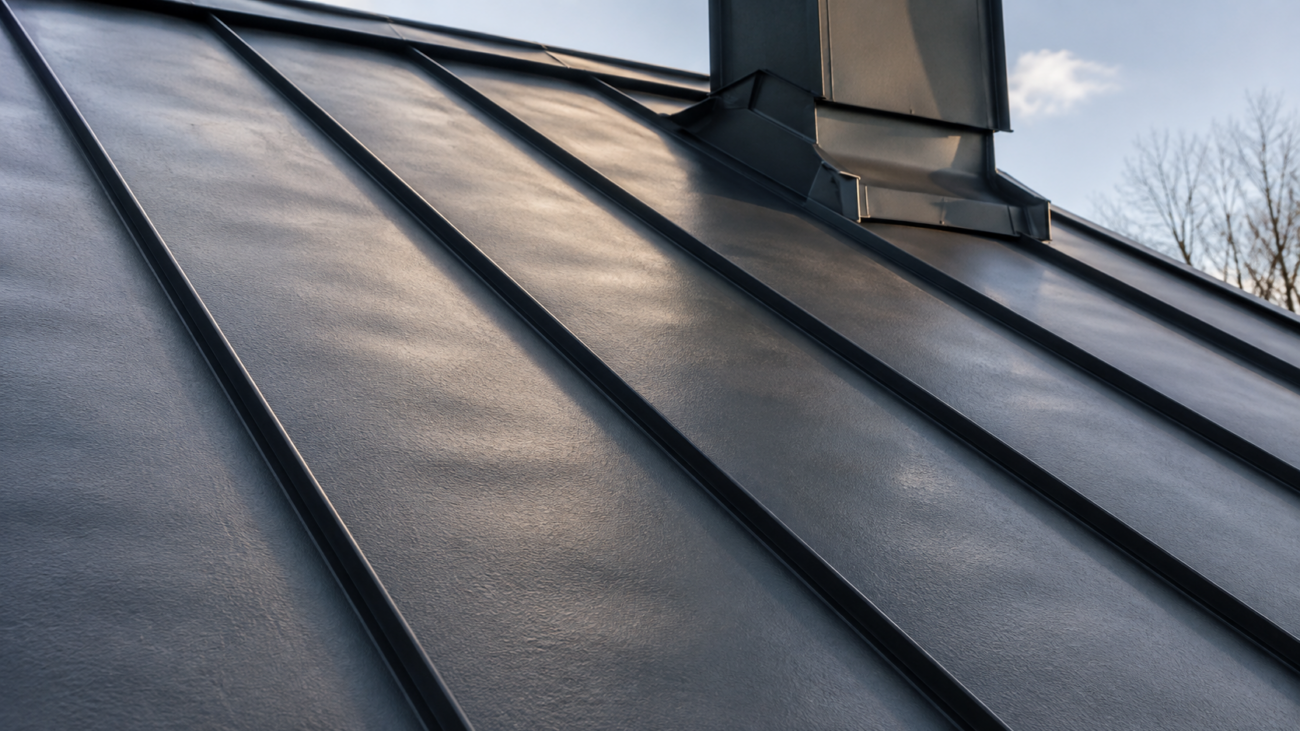
No holes through the panel face. Concealed clips hold each panel to the deck, and adjacent panels lock together at a raised seam that sits above the water line. Rain never sees a fastener. That’s the whole design argument in one sentence, and it’s why standing seam runs 40 to 70 percent more per square.
For a buy-and-hold property with a twenty-year horizon, that math works out. For a two-year flip, it doesn’t.
Thermal movement no one accounts for
A 40-foot steel panel moves roughly a quarter inch between a February morning and an August afternoon. Standing seam handles this with floating clips that let the panel slide. Screw-down systems handle it by fighting it, which is why the holes go oval and the washers wear.
Fix a standing seam panel at both ends — some crews do, out of habit or carelessness — and you’ve removed the one advantage you paid for. Panels buckle. Seams pull open. I’ve seen it on two-year-old roofs.
Galvanic Corrosion: The Chemistry Nobody Checks
Put two dissimilar metals in contact with moisture between them and one of them starts sacrificing itself. Basic chemistry, catastrophic on a roof.
Copper gutters draining onto a steel panel. Galvanized fasteners driven into aluminum. Old lead flashing left around a chimney because tearing it out cost extra. Runoff from pressure-treated lumber, which contains copper compounds that eat galvanized steel with startling enthusiasm.
Year one, nothing. Year three, faint staining at the contact point. Year five, actual pitting, and by then it’s structural.
Where this bites hardest is the seam between two contractors’ work. Roofer does the roof, gutter guy does the gutters six months later, nobody checks material compatibility, and the owner pays for a mistake neither of them will admit to. Ask about metal compatibility before the second trade shows up, not after.
Flashing, Penetrations, and Sealant That Was Supposed to Be Temporary
Every hole in a roof is a future leak that’s been postponed. Chimneys, plumbing stacks, bath fan vents, ridge caps, wall abutments, skylights.
Done right, flashing is mechanical — formed metal that laps water out by geometry alone. Sealant goes on as a secondary layer, backup for the primary detail. Done wrong, sealant is the detail. A crew that runs a fat bead of butyl around a pipe boot and calls it finished has bought you six years, maybe eight in a mild climate.
Sealant is consumable. Say it out loud when you’re reading a bid. If the estimator describes penetrations in terms of caulk rather than formed flashing or properly specified boots, you’re looking at a maintenance schedule disguised as a roof.
Ridge details deserve their own paragraph. Closed-cell foam closure strips at the ridge and eave are cheap, tiny, and constantly skipped. Without them you get wind-driven rain, insects, and birds nesting under corrugation. Sounds minor. It isn’t.
What Goes Under the Panel Matters as Much as the Panel
Metal doesn’t waterproof a roof by itself. The underlayment does a share of the work, and it’s invisible the moment panels go on — which is exactly why it gets cheapened.
Felt paper under metal is a bad idea in the Northeast. Panel surface temperatures hit 160 degrees, felt dries out and cracks, and by year ten there’s nothing down there. Synthetic underlayment handles the heat. High-temp ice and water shield along eaves and in valleys handles the February problem, when ice dams back water uphill.
Then condensation. Metal on an unvented or poorly vented assembly sweats on the underside in winter — warm moist air from inside hits a cold panel and drips onto the deck. Rust that starts on the inside face of the panel and works outward, plus rotting sheathing, plus insulation losing its R-value. Owners chase this for years thinking they have a leak. Proper ridge and soffit venting, or a closed-cell foam assembly if the design calls for it. There’s no third option.
Coatings, Gauge, and Warranty Language That Doesn’t Mean What You Think
Galvalume outperforms plain galvanized in most environments — aluminum-zinc coating, better corrosion resistance, longer life at the cut edges. Worth specifying by name.
Paint system matters more than owners expect. PVDF, sold as Kynar 500, holds color and gloss for decades. SMP is cheaper and chalks noticeably by year twelve. On a rental where curb appeal drives your applicant pool, chalking is a real cost.
Gauge: 29 is thin, 26 is standard for residential, 24 for commercial and premium standing seam. Thinner metal oil-cans more, dents easier, and telegraphs every imperfection in the deck.
Now the warranty. A 40-year manufacturer warranty usually covers finish — fade, chalk, maybe perforation from rust. It covers nothing about installation, and installation is where roofs fail. The contractor’s workmanship warranty is the one that pays for water in a bedroom. Two years is common. Ten is what a serious crew offers. If a company won’t put labor coverage in writing, they’ve told you what they think of their own work.
How to Vet the Crew Before They Touch the Roof
Ask how many metal roofs they installed last year. Not roofs — metal roofs. Shingle contractors take metal jobs when work is slow, and the details don’t transfer.
Ask whether they run standing seam or only screw-down. Ask if they own a brake and roll-form panels on site, or order everything pre-cut. Ask what they do at a chimney, and listen for whether the answer involves formed metal or a tube.
Then ask for addresses of jobs from eight years ago. Anyone can show you a roof they finished last month. A roof that’s been through eight winters tells you everything.
The Failure Timeline on a Badly Installed Metal Roof
Year two or three: a few fasteners back out, a couple of panels tick in the wind. Nobody notices.
Year five: staining at contact points, first rust freckles at cut edges, sealant beads cracking where sun hits them.
Year seven: water at a penetration or a wall abutment. This is when the owner calls somebody, usually for a patch.
Year ten: underlayment is spent, decking has been damp through multiple winters, and the fix is no longer a repair. Full tear-off, on a roof sold as lasting half a century.
Match that against your hold period and the decision makes itself.