housereal. net helps people find, evaluate, and contact agents for residential property. The site aggregates listings, shows market data, and connects users to professionals. This review explains what housereal. net offers, how it works, and when users should try it. The text keeps facts clear and practical for buyers, sellers, and agents.
Key Takeaways
HouseReal.net is a comprehensive real estate platform that helps buyers, sellers, and agents find and connect over residential properties efficiently.
The platform offers updated listings, market data, agent profiles, and tools designed to speed up the home search and transaction process.
Basic browsing and saved searches are free for consumers, while agents can pay for premium placement and lead services tailored to their market needs.
Users should utilize filters, save searches, verify listing details, and read agent reviews to make the most of HouseReal.net’s offerings.
Agents benefit from completing profiles, showcasing recent sales, and engaging promptly with inquiries to maximize leads on HouseReal.net.
HouseReal.net maintains trust by sourcing from public records and broker feeds, but users are advised to confirm details before making offers.
What Is HouseReal.net And Who Is It For?
HouseReal.net is a real estate platform that lists homes, shows market trends, and links users to agents. It serves buyers who want current listings and sellers who want exposure. It also serves agents who want leads and tools to manage contacts. The site pulls public records and agent data to create profiles. Users find property photos, price history, and neighborhood facts. New users can search without signup. Agents can create profiles and pay for enhanced placement. Overall, housereal. net targets everyday home shoppers and real estate professionals.
Key Features And Tools
HouseReal.net groups useful tools in one place. The platform gives listing search, market summaries, agent profiles, and basic transaction helpers. The search aims to reduce time to find relevant homes. The platform updates listings from multiple sources. It also provides simple market charts and recent sale comparables. Agents get lead forms and messaging features. The tools focus on speed and clarity so users can compare options quickly.
Pricing, Fees, And Subscription Options
HouseReal.net uses a mixed pricing model. Basic browsing and saved searches stay free for consumers. Agents pay for premium placement and lead services. The site lists monthly subscription tiers for agent leads, higher visibility, and analytics. It also offers pay-per-lead options in some regions. Pricing varies by market size and competition. HouseReal.net shows plan details on an agent signup page. Users can compare listing exposure before agents commit to a plan.
Trustworthiness, Safety, And User Reviews
HouseReal.net pulls public records and broker feeds to build listings. The site flags listings that lack current status. It asks agents to verify profiles and listing data. Security measures protect user messages and stored favorites. Reviews appear on agent pages and third-party sites. Many users praise fast search and clear photos. Some users note occasional stale listings or contact delays. Overall, housereal. net earns trust where agents maintain profiles and when users confirm details before offers.
Practical Tips For Getting The Most From HouseReal.net
Users should set filters and save searches to avoid repeated work. They should verify price history and public records before scheduling tours. Users should read agent reviews and ask for recent client references. Agents should complete profiles, upload recent sales, and respond quickly to messages. Users should enable alerts and check map boundaries for hidden listings. For competitive markets, users should contact multiple agents through housereal. net and compare plans. These steps help users use housereal. net efficiently and reduce avoidable surprises.
A person finds neighbor issues housereal at home. The person notes noise, property, privacy, or safety problems. The person decides to act calmly and clearly. This article shows steps to identify, talk, document, and use community resources. The reader learns practical actions they can take today.
Key Takeaways
Identifying the specific neighbor issues housereal, such as noise, property damage, privacy, or safety, helps prioritize effective responses.
Approach neighbors calmly and respectfully using clear, simple communication to de-escalate tensions and foster cooperation.
Use prepared scripts and choose appropriate times to discuss concerns, ensuring conversations remain constructive and solution-focused.
Document all incidents factually with dates and times, and understand your local laws and HOA regulations before pursuing further action.
Explore mediation and community resources as practical, non-confrontational ways to resolve neighbor issues housereal before considering legal steps.
Identify The Problem Clearly: Noise, Property, Privacy Or Safety?
Neighbors face many kinds of neighbor issues housereal. A person hears late-night noise. A person finds property damage. A person sees privacy breaches. A person notices safety hazards like loose fencing or broken lights. The person lists facts: what happened, when it happened, and who was involved. The person separates feelings from facts. The person prioritizes safety first. The person uses clear labels: noise, property, privacy, or safety. The person decides next steps based on that label.
Talk With Your Neighbor Respectfully To De‑escalate Tensions
A person prepares to speak before confronting a neighbor issues housereal. The person chooses a calm time to talk. The person avoids blaming words. The person uses short statements like “I hear loud music after 10 p.m.” The person listens when the neighbor replies. The person keeps the tone low and the sentences simple. The person offers small solutions such as adjusting hours or trimming branches. The person notes outcomes and plans a follow-up if needed.
What To Say And When To Talk: Simple Scripts And Timing Tips
A person picks morning or early evening to speak. A person avoids late nights and high-stress moments. Use this script: “I live next door. I hear loud noise after 10 p.m. Can we agree on quieter hours?” A person uses this script for property: “I found some damage to my fence. Did you see this?” A person uses this script for privacy: “Your cameras point toward my yard. Can we change the angle?” A person ends the talk with a clear next step.
Document The Issue And Know Your Rights
A person records neighbor issues housereal before taking legal steps. The person keeps dates, times, and short notes. The person checks local noise laws and property rules. The person reads HOA rules when applicable. The person learns basic tenant or homeowner rights from local government sites. The person avoids threats and keeps records factual. The person shares the records with authorities or mediators if the issue continues.
Use Mediation, Community Resources, And HOA Options Before Suing
A person tries mediation before filing lawsuits over neighbor issues housereal. A person contacts a community mediation service or local dispute center. A person asks the HOA to review violations when the property falls under HOA rules. A person brings records and concise points to mediation. A person aims for a practical agreement that both sides can follow. A person keeps communication professional and focused on solutions rather than blame.
HouseReal guides can help real estate investors housereal find actionable deals in 2026. The guide shows where to look, what numbers to run, and how to decide. It gives clear steps that save time and reduce risk. The reader will get a repeatable process to find, evaluate, and win HouseReal deals fast.
Key Takeaways
HouseReal guides provide real estate investors housereal a clear, repeatable process to find and evaluate profitable deals quickly and with reduced risk.
Tracking market signals like mortgage rates, inventory, and rental demand helps real estate investors housereal identify undervalued HouseReal opportunities before competitors.
A step-by-step evaluation framework—including location screening, financial analysis, and scenario planning—helps investors make objective decisions and avoid emotional bias.
Key financial metrics such as cash flow, cap rate, ROI, and ARV give real estate investors housereal essential insights to assess deal viability and compare investment options.
Matching financing options to investment strategy and using strategic offer tactics increase success rates while managing risk conservatively protects capital.
Standardizing sourcing, underwriting, and closing processes enables real estate investors housereal to build a scalable and efficient investment pipeline for sustained growth.
Why HouseReal Opportunities Matter Right Now
HouseReal opportunities matter because market shifts create gaps that real estate investors housereal can exploit. Mortgage rates, inventory cycles, and local demand shape where value appears. He or she who tracks these signals can spot discounts before others. HouseReal listings often surface where sellers need speed or where upgrades add clear value.
Investors should watch price trends, days-on-market data, and rental demand. HouseReal tools help filter listings by criteria such as needed repairs, cash-flow potential, and neighborhood comps. They let investors housereal compare offers quickly and avoid weak deals.
Market data now shows pockets of strong rent growth in secondary cities. HouseReal buyers can target those areas and aim for positive cash flow. The method lowers reliance on appreciation and raises resilience to rate swings.
Teams that move fast win. HouseReal systems let investors housereal streamline underwriting, prepare offers, and close sooner. Speed matters when multiple buyers bid on the same property.
Step-By-Step Evaluation Framework For HouseReal Properties
He or she should follow a clear evaluation framework when reviewing HouseReal assets. Step 1: screen for location, price band, and condition. Step 2: run core financials. Step 3: verify comps and rents. Step 4: stress-test the deal for vacancy and repairs. Step 5: decide and make the offer.
This framework helps real estate investors housereal avoid emotional decisions. It forces objective checks and repeatable math. The investor can use a checklist with minimum yield, maximum repair cost, and acceptable vacancy rate.
The investor should set exit scenarios. One scenario assumes hold and rent. Another assumes fix-and-flip. Real estate investors housereal can compare net proceeds and time to liquidity for each scenario. The comparison reveals which strategy gives the best risk-adjusted return.
Due diligence should include title review, permit checks, and a contractor estimate. The contractor estimate should list items by cost and timeline. That step keeps the HouseReal budget realistic and prevents surprises.
Key Financial Metrics To Calculate (Cash Flow, Cap Rate, ROI, ARV)
Cash flow shows monthly profit after expenses. The investor subtracts mortgage, taxes, insurance, management fees, and maintenance from rent. Real estate investors housereal must model conservative vacancy and maintenance allowances.
Cap rate equals annual net operating income divided by purchase price. The investor uses cap rate to compare markets and to screen deals quickly. A higher cap rate signals higher income relative to price, but it can also signal higher risk. Real estate investors housereal should compare cap rates to local market averages.
ROI captures total return over a hold period. The investor includes cash flow, principal paydown, and appreciation. Real estate investors housereal can annualize ROI to compare to other investments.
ARV, or after-repair value, matters for flips and heavy renovations. The investor estimates ARV using recent comps of renovated homes. The investor then subtracts repair costs and transaction costs to get a safe maximum purchase price. Real estate investors housereal should apply a margin of safety to ARV to avoid overpaying.
Each metric gives specific insight. Cash flow tests monthly viability. Cap rate tests income yield. ROI tests total return. ARV tests renovation upside. Together they give a clear numeric view of any HouseReal deal.
Financing, Offer Strategies, And Risk Management For HouseReal Deals
The investor should match financing to strategy. For buy-and-hold, long-term mortgages lower monthly cost. For flips, short-term loans or hard money speed execution. Real estate investors housereal must compare interest, points, and allowable repair draws.
Offer strategy affects win rate. The investor can use clean offers with proof-of-funds to reduce seller friction. Alternatively, the investor can offer quick inspection windows and flexible close dates to gain advantage. Real estate investors housereal should avoid inflated offers that leave no margin for error.
Risk management requires conservative assumptions. The investor should stress-test cash flow for higher vacancy and higher repair costs. They should keep contingency reserves for surprise expenses. Real estate investors housereal can set a rule: never commit more than a set percentage of capital to a single deal.
Insurance and legal checks reduce long-term exposure. The investor should confirm property insurance and review lease templates if renting. Real estate investors housereal should also document contractor contracts and timelines.
Finally, the investor should build a repeatable pipeline. Sourcing, vetting, financing, and closing should follow documented steps. Real estate investors housereal who standardize these steps will scale without adding excessive risk.
home location guides housereal help buyers compare neighborhoods quickly. The guide lists commute times, school ratings, crime stats, and local services. It shows cost ranges and zoning basics. It points to data sources and field checks. Buyers use the guide to narrow choices and plan visits. The text stays direct to speed decision making and reduce research time.
Key Takeaways
Home location guides housereal provide comprehensive neighborhood data like commute times, school ratings, crime stats, and amenities to help buyers quickly compare and narrow down options.
Effective use of home location guides involves checking commute efficiency, school quality, crime trends, and local services to match lifestyle and budget needs.
Buyers should evaluate affordability by analyzing costs including taxes and insurance, review zoning laws, and consider future growth projects to anticipate neighborhood changes.
Field visits at different times allow buyers to observe local character, noise levels, service availability, and community investment to validate guide information.
Combining home location guides housereal data with on-the-ground observations and local insights leads to more informed and confident neighborhood decisions.
Timing the market by tracking listing durations and price changes helps buyers align offers with current market conditions and personal timelines.
What Home Location Guides Are And How To Use Them Effectively
Home location guides housereal present neighborhood facts in a single view. They collect public data, maps, and local listings. Buyers read the guide to compare areas on the same metrics. The guides rank commute time, school quality, safety, and services. They display price ranges and recent sale trends. Buyers use filters to match budget and lifestyle. Brokers add notes on development plans and transit projects. Buyers treat the guide as a filter, not a final answer. They confirm key facts with official sources and local contacts.
Key Data Points To Check In Any Location Guide (Commute, Schools, Crime, Amenities)
Buyers check commute time first. They measure drive and transit times during peak hours. They check transit frequency and route reliability. Buyers verify distance to major employers. They log realistic daily travel time.
Buyers review school ratings next. They note test scores, enrollment size, and special programs. They read recent inspection reports and parent reviews. They visit schools when possible to see class size and facilities.
Buyers examine crime statistics next. They look at trends over several years. They compare violent and property crime per 1,000 residents. They check police response times and community policing efforts. They read local news for context on incidents.
Buyers tally amenities last. They count grocery stores, clinics, parks, and gyms within a 10-minute drive. They check walkability scores and bike lanes. They note evening and weekend activity levels. They list essential services that affect daily life.
How To Evaluate Neighborhood Essentials: Affordability, Zoning, And Future Growth
Buyers assess affordability by comparing listed prices to recent sales. They calculate monthly housing costs with taxes, insurance, and utilities. They test different down payment and mortgage rate scenarios. They set a clear top price and a safe backup.
Buyers read zoning maps to check allowed uses. They confirm single-family, multi-family, and commercial designations. They check overlays for historic districts and design rules. They contact the local planning office for pending rezoning cases. They ask about accessory dwelling rules and rental limits.
Buyers evaluate future growth by reading city plans and permit logs. They check pipeline projects for housing, retail, and transit. They look for announced infrastructure dollars and job site expansions. They note projects that may raise traffic or noise.
Buyers weigh growth impact on taxes and services. They estimate how new supply could affect prices. They consider both near-term construction disruption and long-term value change. They talk with local brokers to get on-the-ground insight.
Fieldwork: Visiting Areas, Timing Your Search, And Observing Local Character
Buyers plan visits at different times of day. They visit on a weekday morning, a weekday evening, and a weekend. They watch rush-hour flow and transit crowding. They listen for noise from highways, trains, and nightlife. They walk main streets and side blocks to compare safety and upkeep.
Buyers speak with residents when possible. They ask about local schools, garbage pickup, and neighborhood meetings. They ask how long people have lived there and why they stay. They note tone and consistency in resident answers.
Buyers record practical details during each visit. They photograph sidewalks, signage, and parking. They time a commute from the address to work and school. They test cell and internet signal in the house and yard.
Buyers check nearby services during the visit. They enter grocery stores, clinics, and transit stops to see operating hours and crowding. They note the presence of small businesses and restaurants and whether they look stable. They mark the closest emergency services by distance and drive time.
Buyers assess local character by watching everyday routines. They observe people using parks, walking dogs, and biking. They note the mix of housing styles and yard care. They watch for short-term rentals and boarded properties. They interpret these signs as indicators of community investment.
Buyers time the market by tracking listing age and price changes. They note whether homes sell fast or linger. They adjust their offer strategy based on supply pressure and local trends. They set a timeline that matches their needs and the market rhythm.
Buyers combine guide data with fieldwork to make choices. They treat home location guides housereal as a starting map. They use visits and documents to confirm fit. They pick the neighborhood that meets their daily needs and future plans.
law housereal guides readers through basic real estate law for buying and owning homes. The guide explains duties, rights, and common risks in plain terms. It shows which documents matter, when to get legal help, and what people should expect at closing. The text aims to help buyers and owners make clear, calm choices.
Key Takeaways
Law housereal clarifies essential real estate law concepts to help buyers understand their rights and duties during home purchases.
Reviewing title records and disclosures early is critical to avoid hidden defects and protect your ownership under law housereal.
Purchase agreements and contingencies must be clear and complete to enforce conditions and secure refunds if necessary.
Law housereal emphasizes the importance of inspections, appraisals, and HOA rules for informed decisions and risk mitigation.
Consulting a real estate attorney early can prevent disputes, ensure compliance, and streamline the closing process.
Keeping accurate records and understanding closing documents safeguard buyers from future legal issues under law housereal.
How Real Estate Law Shapes The Homebuying Process
Real estate law sets rules that buyers and sellers must follow. law housereal defines who owns land, how ownership transfers, and how lenders secure loans. It sets deadlines for inspections, disclosures, and deposits. It also sets what remedies each side may use if a party breaks a promise.
A buyer should check title records before signing. law housereal requires sellers to disclose known defects in many states. A lender will order a title search and title insurance to protect its interest. A buyer will review those results and may ask the seller to fix issues or offer a credit.
Purchase agreements state price, dates, contingencies, and who pays closing costs. law housereal makes contingencies enforceable when they clearly state conditions, such as inspection or appraisal approval. If a contingency fails, a buyer may cancel and get a deposit back if the contract allows it.
Inspections and appraisals matter. An inspector reports visible issues with structure, systems, and safety. An appraiser sets a market value that lenders use. law housereal limits a lender from making a loan above the appraised value without extra borrower steps.
Buyers should read HOA rules and covenants. law housereal gives homeowners associations the power to enforce community rules and collect fees. A buyer will check pending assessments and enforcement history. Unpaid HOA fees can become lienable debts that follow the property.
A closing transfers ownership. law housereal lists documents that must be recorded to give public notice of the change. Recording protects the buyer from later claims. The closing statement shows payments, fees, and who paid what. Buyers will confirm that property tax and utility proration match the contract.
Buyers may face common legal risks. Title defects, undisclosed damage, and contract default carry real costs. law housereal provides remedies like specific performance, damages, or rescission. A buyer should plan for possible disputes and know local deadlines for claims.
Key Legal Documents, Contracts, And Closing Essentials
A real estate transaction uses specific documents that set rights and duties. law housereal identifies the main documents: the purchase agreement, deed, mortgage or deed of trust, title report, closing statement, and disclosures. Each document serves a clear purpose.
The purchase agreement lists the price, deposit, contingencies, closing date, and who pays certain costs. law housereal treats the purchase agreement as the contract that governs remedies and timelines. Parties should confirm all blank fields are complete and any verbal promises appear in writing.
The deed transfers ownership. law housereal requires the deed to describe the property and name the grantee. A buyer should verify that the deed type matches their need. A warranty deed gives wider protection than a quitclaim deed.
A mortgage or deed of trust secures the loan. law housereal allows a lender to foreclose if a borrower defaults. Borrowers should compare loan terms, including interest rate, fees, and prepayment rules. The promissory note lists repayment terms: the mortgage lists the lender’s security interest.
The title report shows recorded liens and owners. law housereal encourages buyers to buy title insurance. Title insurance protects against past defects that the title search missed. An owner’s policy covers the buyer: a lender’s policy covers the lender’s interest.
Disclosures tell buyers about known property problems. law housereal requires sellers to disclose issues like water damage, lead paint where applicable, and known legal claims. Buyers should read disclosures early and follow up with targeted inspections.
The closing statement lists costs and payments. law housereal requires accurate accounting so parties know final payoffs, prorations, and fees. Buyers should confirm that seller credits, loan payoffs, and escrow deposits match the agreed terms.
After closing, recording documents creates public notice. law housereal makes recording essential to protect ownership rights. A buyer should keep copies of all recorded documents and insurance policies.
When To Consult A Real Estate Attorney And What To Expect
People call an attorney when a deal has legal complexity or a dispute. law housereal recommends legal counsel if title issues, contested boundaries, or unusual contract terms appear. A buyer should also hire an attorney when state law favors attorney review at closing.
An attorney will review contracts and explain legal risks. They will point out vague clauses and suggest changes to protect a client. The attorney will also check title reports, liens, and recorded easements. If the title shows a problem, the attorney will advise on cure options or insurance.
When a dispute arises, an attorney will explain rights and deadlines for claims. They will negotiate with the other side or file suit if needed. law housereal allows remedies like specific performance or damages, but local rules set time limits and procedures.
At closing, an attorney may attend and confirm that documents match the contract. They will verify that loan payoffs and seller obligations appear on the closing statement. The attorney will advise a client before they sign and can hold funds in escrow if the contract allows it.
Clients should expect clear fees and a scope of work. law housereal suggests asking for a written engagement that lists tasks, costs, and timing. Some attorneys charge flat fees for closings: others charge hourly rates for disputes and complex reviews.
A buyer should act early. Early attorney involvement may prevent last-minute surprises. law housereal rewards early review with faster closings and fewer post-closing claims. An attorney can close gaps that otherwise create liability for a buyer or owner.
If a client prefers DIY for a simple sale, they should still read each document and ask focused legal questions. law housereal supports informed choices and clear record keeping so owners can protect their investment.
Selling a home is a major decision, and most owners want to get the best possible price. The good news is that you do not always need a full remodel to make your property more appealing.
Small updates, better presentation, and basic repairs can make a strong difference. Buyers often notice how clean, bright, and well cared for a home feels. By focusing on the right areas, you can improve first impressions and help your home stand out in the market.
Focus on Repairs That Buyers Notice
Before making large upgrades, take care of small repairs around the home. These details may seem minor, but buyers often notice them during a showing.
Fix loose handles, dripping faucets, damaged trim, cracked tiles, and doors that do not close properly. Check light switches, outlets, and other simple features too.
A home with fewer visible problems can feel better maintained. This may give buyers more confidence in the property.
Do not spend money on repairs that add little value. Focus first on issues that affect appearance, comfort, or daily use.
Make Smart Updates in Key Rooms
Kitchens and bathrooms often receive extra attention from buyers. You do not always need to rebuild these rooms completely.
Simple updates can make them feel newer. You might replace old cabinet handles, add fresh paint, improve lighting, or update a worn faucet.
Other useful upgrades may include:
New light fixtures
Fresh wall paint
Updated hardware
Clean countertops
Modern mirrors
Energy-saving updates can also be appealing. Newer windows, better insulation, or efficient lighting may help lower future costs.
Homeowners comparing different ways to sell may also come across companies such as CavaBuys when looking at local selling options.
Before starting any large project, think about the cost and how much value it may add. A smaller update may offer a better return.
Stage the Home to Feel Open and Bright
Good staging helps buyers imagine living in the home. The goal is to make each room feel clean, open, and easy to understand.
Start by removing clutter. Clear counters, tables, and crowded shelves. Store extra furniture if it makes a room feel small.
Personal items such as large photo displays can also be reduced. Buyers may find it easier to picture their own belongings in a more neutral space.
Natural light is another important part of staging. Open curtains and blinds before showings. Add lamps to darker rooms if needed.
Improve Curb Appeal Before Showings
The outside of the home creates the first impression. Buyers may form an opinion before they even walk through the front door.
Start with basic yard work. Trim bushes, mow the lawn, remove weeds, and clear leaves or debris.
Clean the front walkway and porch. A pressure wash may help remove dirt from some surfaces.
The front door should also look clean and cared for. Fresh paint, a simple door mat, or updated house numbers can make the entrance more welcoming.
Conclusion: Prepare Your Home to Sell With Confidence
Improving your home’s value before selling does not have to mean a major renovation. Small repairs, simple updates, better staging, and stronger curb appeal can all make a difference.
Focus on the parts of the home that buyers notice first. Keep spaces clean, bright, and easy to picture as a future home.
Start with a simple walk-through of your property today. Make a short list of repairs and updates, then tackle the most important ones first to help your home make a stronger impression on buyers.
If you’d like to learn more, check out more articles on our blog.
Commercial real estate invented the stacking plan, and then spent four decades treating it as private correspondence. Floors down the left, tenants in the blocks, square footage and lease expiry annotated in six-point type. It came out of a Yardi export or an Excel file maintained by whoever inherited it, it was reviewed at the quarterly asset meeting, and it was shown to lenders, joint-venture partners and the occasional broker preparing a pitch. It was never meant for a tenant.
That assumption has quietly stopped holding. A tenant looking for 18,000 square feet now behaves almost exactly like a renter looking for a one-bedroom: they start online, they shortlist before they call anyone, and by the time a broker hears from them they have already formed opinions about four buildings. The soft office market accelerated this. When a tenant has leverage and options, they use both, and most of that comparison happens on a Tuesday evening with no agent in the room.
So the availability information that used to be handed over in a PDF after a phone call is now the first impression for many tenants and in many cases the only one. If they cannot find what they need quickly, they move on to the next building. A gated PDF is a filter that removes exactly the tenants who were still deciding.
Why a commercial stacking plan is harder than a residential one
It is tempting to look at what condo developers have built over the last five years and assume it ports directly. It does not, and the differences are worth naming, because they are where most generic tools fail.
Contiguity. A condo buyer wants one unit. An office tenant wants a block, and the block usually has to be vertically contiguous. The single most valuable question a leasing diagram can answer is whether the building can hold this tenant at all: Can I assemble 40,000 square feet across adjacent floors, or is my requirement scattered across floors 4, 11 and 19 with three separate lobbies’ worth of operational friction? A list of available suites answers that badly. An elevation answers it at a glance, which is why the format was invented in the first place.
Divisibility.Available space in a commercial building is not fixed in the way a condo unit is. A full floor of 22,000 square feet might be marketed as one floor, two halves, or three suites depending on who is asking. The diagram has to represent a space that is simultaneously one thing and three things.
Rollover. Occupied does not mean unavailable. A floor with a lease expiring in fourteen months is a live opportunity for a tenant with a fifteen-month runway, and it is invisible on any diagram that only models occupied and vacant. Encoding expiry dates turns the plan from an availability snapshot into a forward-looking leasing instrument. It also puts information on the plan that brokers are often already pulling together from the rent roll.
Mixed use.A building with retail at grade, office in the middle and rental apartments above is now common, and it means one diagram serving three product types with three sales cycles, three audiences and three definitions of what a “unit” is. Most tools were built for one of those and bolted on the others, which is why commercial and mixed-used buildings can require a different approach than residential-focused platforms typically provide.
The objection worth taking seriously
Plenty of landlords do not want asking rents public, and that is a defensible position rather than a technophobic one. Published rates set a reference point in every subsequent negotiation, and they are visible to competitors across the street.
But that is a concern about pricing, not availability. A diagram that shows which floors are open, how much space each represents, whether they can be combined and when the neighbouring lease rolls delivers most of the qualifying value while leaving rates to a conversation. The tenant who learns the building can accommodate them still has to call. They just call better informed, and they call you rather than the building that made them fill in a form to find out.
The maintenance problem is the whole problem
An interactive availability diagram is, implicitly, an assertion that what is on screen is true today. That assertion is easy to make and expensive to keep. A leasing plan showing a suite that went firm three weeks ago is worse than a PDF, because the PDF at least carried a date on it and the tenant discounted it accordingly.
That is one reason the workflow behind the diagram matters as much as the diagram itself. Some newer platforms, includingPlanpoint’s interactive stacking plan, put the update process in the hands of the leasing team rather than treating changes as a separate production request. For a building where availability changes regularly, that distinction can matter more than the number of features listed on a product page.
There is a second-order benefit that landlords tend to discover late. Once the stacking plan is maintained continuously because it is public, the internal version stops being a quarterly reconstruction. Asset management and marketing end up reading the same file instead of two documents that agree in January and diverge by March.
What this actually changes
Not much, on the surface. The stacking plan looked like this in 1985, and it looks like this now, because the format was correct the first time. Floors down the side, blocks across, colour for status. The interactive version does not need to change that basic language.
What changes is who is allowed to read it. For most of its history, the stacking plan was a document about a building shown to people who already had a relationship with the building. It is now, increasingly, the way a stranger decides whether to start one. For a document that spent most of its life inside the asset management team, that is a significant shift. It may deserve more attention than it currently gets in a leasing budget that still spends most of its money on photography.
Lifetime warranties sound like forever coverage—until you read the fine print. One Van Nuys vinyl-fence installer defines “lifetime” as just 30 years and still charges homeowners for teardown and re-install labor—a gap that can cost thousands.
That gap is why we audited every licensed vinyl-fence contractor actually working in Van Nuys. We scored written terms, materials, reviews, turnaround, and quote clarity. Inside, you’ll get clear rankings, a side-by-side warranty table, and the zoning checkpoints most blogs skip, so you know exactly which clause to circle before you sign.
How we ranked Van Nuys vinyl fence companies
Every contractor had to clear five checkpoints before we even scored them:
Local proof – recent Van Nuys projects, a storefront, or on-site fabrication.
Active C-13 license – verified on the CSLB portal with current bond and workers’ comp.
30-plus independent reviews – Google, Yelp, Houzz, or Nextdoor, all published within the past five years.
Vinyl focus – a documented portfolio or product line dedicated to vinyl fencing (not just a side offering).
Written warranty access – a publicly available document that spells out material and workmanship terms, not just the word “lifetime” in marketing copy.
Six companies met every requirement. A seventh remains on our watch list until its license, review count, and warranty PDF are confirmed.
(Weighted scoring—warranty 25 percent, materials 20 percent, reviews 20 percent, turnaround 15 percent, quote transparency 10 percent, local support 10 percent—kicks in only after a company clears these gates. Criteria last verified August 13, 2026. See the next section for details.)
Van Nuys vinyl fence companies at a glance
Need the facts in one scroll? The table below shows each finalist’s score, local base, review volume, and the warranty terms most homeowners check first. Figures were last verified August 13, 2026.
Rank
Company
Weighted score
Local base
Google / Yelp reviews
Material warranty
Workmanship warranty
Transferable?
CSLB number*
1
Vinyl Fence Depot
91.0
Van Nuys showroom and fabrication
Thousands of installs
Limited lifetime plus fade
Term pending doc
Yes
Unlisted
2
Pro Vinyl Fencing
87.7
Sun Valley HQ
4.9 / 4.8 (400 +)
“Limited lifetime” = 30 years
5 years
One-time
1104338
3
GNG Vinyl Fencing
85.8
Glendale design gallery
4.8 / 4.5 (590 +)
Lifetime product
Not posted
Yes
884502
4
Vinyl Concepts
76.9
Newbury Park and Torrance
4.6 (180 +)
Lifetime (manufacturer)
Not posted
Likely
876205
5
Vinyl Fence Mart
74.9
Northridge shop
5.0 (200 +)
Lifetime (self-stated)
Not posted
Yes
1105493
6
Customize Vinyl Fencing
72.8
Northridge office
5.0 (90 +)
Lifetime (needs doc)
Not posted
Yes
1069347
7†
Pacific Vinyl Fences
58.6
Glendale yard
4.6 (22)
Not published
Not published
—
—
*License numbers should be re-checked on the CSLB website the week you sign.
†Pacific’s place is provisional until its license, warranty PDF, and 30-review threshold are confirmed.
Use the grid as a launchpad. The deep dives below explain why Vinyl Fence Depot leads, where Pro Vinyl’s fine print tightens, and which questions to ask before any deposit changes hands.
1. Vinyl Fence Depot: best overall for local fabrication and full-spectrum warranty
Vinyl Fence Depot cuts and assembles every panel of its rigid PVC—formulated with titanium-dioxide pigment for UV stability—inside one Van Nuys building that houses the showroom, warehouse, and fabrication line. Stock stays on hand, custom sizes leave the shop the same day, and the company’s site details its best vinyl fence options for privacy so you can walk in already picturing which tongue-and-groove profile will screen your yard from view.
Vinyl Fence Depot Van Nuys showroom and fabrication website screenshot
Why it ranks first
Full-spectrum warranty. Limited lifetime transferable coverage on residential material, a 30-year commercial term, and lifetime protection against discoloration.
Local control. In-house crews measure, fabricate, and install, which shortens lead times and keeps communication tight.
Solid social proof. Multiple Talk Awards (2011 to 2020) and a Shield award, plus features in Home Improvement Guide, The Localist, Home Magazine, and Local Contractor Magazine.
Consumer-friendly contract. Free on-site estimate followed by a contract with a 10 percent deposit before fabrication and installation.
Smart checks before you sign
Ask for the full warranty PDF and confirm whether approved color-fade claims cover labor.
Verify the CSLB license is active the week you pull permits.
Inspect a showroom gate: wide openings should include the company’s standard internal-steel frame.
Need one shop that designs, builds, and stands behind every rail? Vinyl Fence Depot operates at 14700 Oxnard Street in Van Nuys (with a second location at 26210 Bouquet Canyon Road in Santa Clarita). Reach them at (818) 989-9940 or [email protected]. (Details verified August 13, 2026.)
2. Pro Vinyl Fencing: best for a crystal-clear warranty and strong reviews
Pro Vinyl publishes its full policy online, line-numbered and plain-English: “limited lifetime” equals 30 years, and workmanship is covered for five. Material defects stay protected, but removal and re-install labor shifts to you once the five-year labor term ends.
Pro Vinyl Fencing clear warranty policy website screenshot
Why it ranks second
Transparent paperwork. The complete warranty PDF is one click away and spells out transfer rules (one transfer, notice within 30 days).
Review strength. 414 Google reviews average 4.9 stars (verified August 13, 2026).
Financing option. Zero-percent plans advertised for qualified buyers; ask for the current annual percentage rate and term length.
Active license. CSLB number 1104338, valid through May 31, 2027.
Smart checks before you sign
Staple the latest warranty PDF to your contract and confirm which address—Sun Valley or Burbank—handles future claims.
Ask in writing who pays labor if a panel fails in year 15.
Request financing details in annual-percentage-rate format before accepting “zero percent” marketing.
When crystal-clear paperwork matters as much as the fence itself, Pro Vinyl remains hard to beat.
3. GNG Vinyl Fencing: best for financing and strong social proof
More than 590 public reviews—154 on Google and 436 on Yelp, averaging 4.7 stars (snapshot August 13, 2026)—put GNG near the top of the chatter curve.
GNG Vinyl Fencing financing and design gallery website screenshot
Why it ranks third
Flexible financing. Spread payments over time while locking today’s material price. Ask for the current annual percentage rate and term length; past promos have offered 12 or 18 months at zero percent for qualified buyers.
Transferable lifetime material warranty. Coverage follows the property, not just the first owner.
Hands-on design gallery. The Glendale showroom lets you test gate frames and compare full-height panels in real sunlight.
What to verify before signing
Obtain the workmanship warranty PDF and confirm who pays labor on an approved material claim.
Clarify extrusion details—brand, wall thickness, and color-fade coverage.
Recheck CSLB license number 884502 for active status and workers’ compensation coverage the week you sign.
Get financing terms in writing: annual percentage rate, payment schedule, and any early-payoff fees.
GNG pairs a deep review history with payment flexibility—ideal if you want to finance the project and still see real hardware before you commit. Complete the warranty and financing homework first.
4. Vinyl Concepts: best for long experience and HOA-level paperwork
Vinyl Concepts has completed nearly 30 years of Los Angeles County installs, and that history matters when an HOA needs stamped drawings or a city reviewer requests revision three.
Why it ranks fourth
Proven track record. Founded in 1997 with thousands of completed projects and an A+ BBB rating.
Two showrooms. Newbury Park and Torrance locations display full-height privacy panels, wood-tone textures, and reinforced gates.
Employee crews. The company runs its own installation teams, avoiding subcontract hand-offs.
Paperwork depth. Staff prepare HOA packets and commercial plan sets, a plus when approvals can slow a timeline.
Numbers to know (verified August 13, 2026)
Google rating 4.6 from 180-plus reviews.
CSLB license number 876205, active to November 30, 2027.
Warranty: lifetime manufacturer coverage on PVC; labor term not published—request it in writing.
Checks before signing
Ask whether the lifetime material warranty transfers and whether labor is included on approved claims.
Confirm lead time to secure HOA architectural approval—who files and what the fee is.
Schedule an early-day showroom visit; afternoon traffic on the 101 can double the drive from Van Nuys.
If your fence must pass an HOA committee or a commercial plan check, Vinyl Concepts brings the paperwork muscle to clear the red tape—just pin down the labor warranty first.
5. Vinyl Fence Mart: best for quick turnaround and a shop around the corner
Northridge is only minutes from Van Nuys, and it houses Vinyl Fence Mart’s retail showroom where homeowners can examine full-height panels and leave with an itemized quote in minutes.
Why it ranks fifth
Fast lane. Recent Google reviews (198 total, 5.0-star average as of August 13, 2026) mention installs scheduled within a week once permits clear.
Walk-in showroom. Need a replacement post cap at 4 p.m.? The counter stocks common parts.
Warranty: the website promises a lifetime material term but does not publish the document—request the PDF and ask whether labor is covered.
License: verify CSLB license number 1105493 is active and matches the contracting entity on your proposal.
Quote scope: confirm demolition, haul-away, and sprinkler protection are line items, not assumptions.
If speed and face-to-face service matter more than a deep warranty track record, Vinyl Fence Mart delivers—just collect the paperwork before you hand over that 10 percent deposit.
6. Customize Vinyl Fencing: best for color variety and detail-driven projects
If you want cocoa-brown ranch rails or a driftwood-gray gate cut to a 37-degree garden angle, Customize Vinyl Fencing is the local “yes-we-can” shop.
Why homeowners choose Customize
Color depth. Review photos show chocolate, driftwood, and charcoal panels that larger shops do not stock.
Hands-on owners. Yelp average 5.0 from 88 reviews (snapshot August 13, 2026) mentions text updates with photo mock-ups and on-site tweaks before concrete sets.
Local turnaround. Northridge fabrication keeps small runs from waiting on freight.
Due-diligence checklist
Request the written material and workmanship warranties; confirm whether custom colors carry separate fade coverage.
Verify CSLB license number 1069347 is active—renewal was due September 30, 2026.
Ask how many linear feet qualify as a “small project” for expedited scheduling.
Confirm metal reinforcement in gates and long privacy runs.
Choose Customize if matching your pergola’s exact taupe matters more than showroom square footage—but tighten the paperwork before you approve those one-off hues.
7. Pacific Vinyl Fences: promising but still under review
Neighbors on Nextdoor and BestProsInTown praise Pacific Vinyl Fences for neat work and friendly crews, yet public evidence is limited: 22 online reviews with a 4.6-star average (verified August 13, 2026), and the company website lists no CSLB license number.
What is missing
License. We could not locate an active C-13 license in the CSLB database.
Warranty PDFs. The site mentions a lifetime warranty but offers no document or exclusions.
Ask the owner for the CSLB license number and verify it on cslb.ca.gov before paying a deposit.
Request the complete material and workmanship warranties—labor coverage, transfer terms, and color-fade clauses should be explicit.
Tour at least one finished job and speak with the homeowner about any post-install issues.
Pacific Vinyl Fences could move into the top five once it publishes its license and warranty terms and expands its review base. Until then, treat it as a watch-list option while you collect bids from fully vetted installers.
The warranty clause most homeowners skip
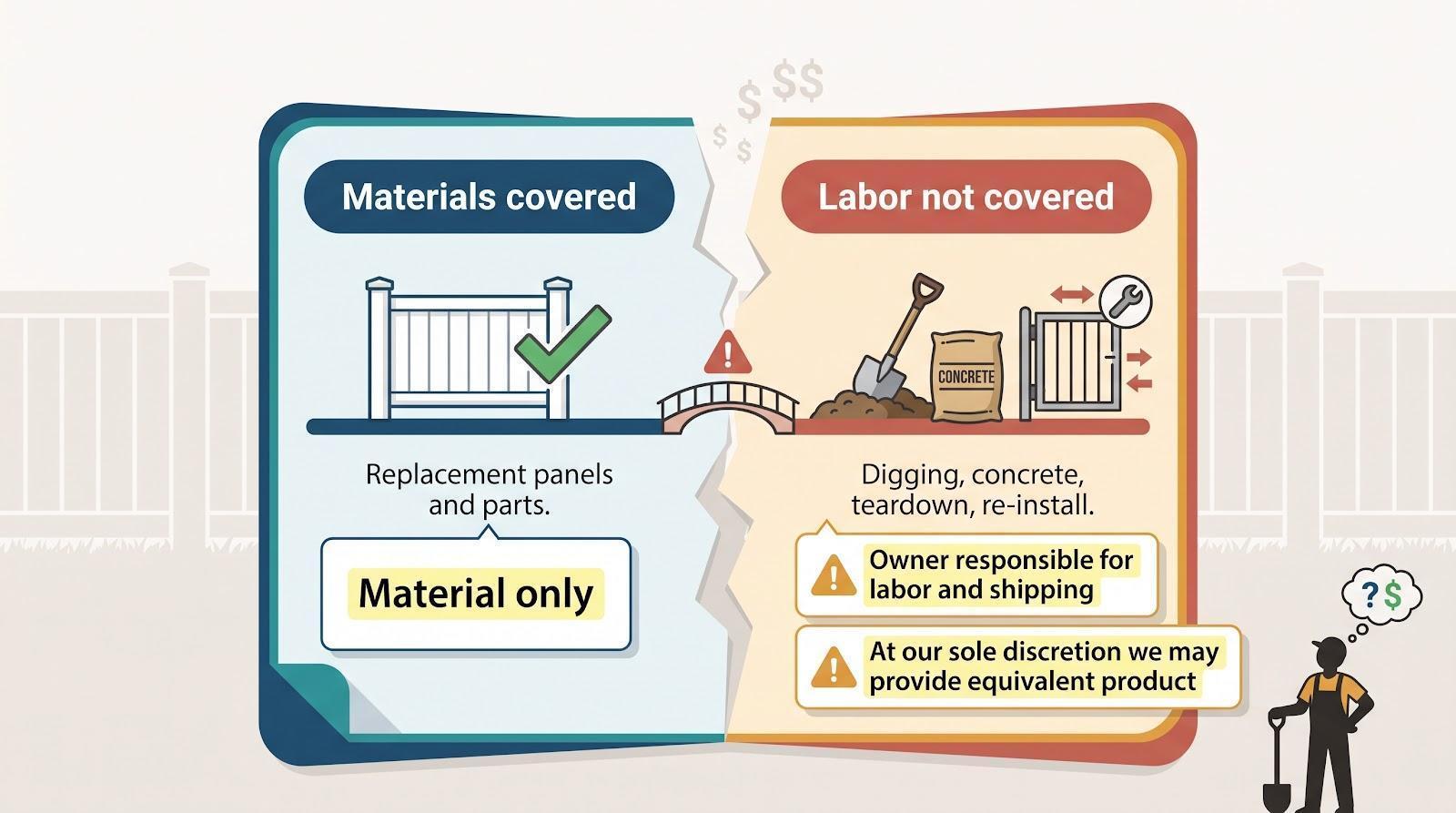
Most vinyl warranties promise replacement materials rather than the labor to dig out a cracked post, pour new concrete, or rehang a gate. One public policy (Pro Vinyl, revised February 2026) states that the owner “is responsible for removal, disposal, and re-installation costs” after year five. The Federal Trade Commission advises reading these terms before purchase and getting verbal promises in writing.
How to spot the labor gap
Look for any of these phrases in the fine print and highlight them when you review the PDF:
“Material only”
“Owner responsible for labor and shipping”
“At our sole discretion we may provide equivalent product”
Five questions to ask before signing
Does “lifetime” mean the product’s life or a fixed number of years?
Is labor included for approved material defects, and if so, for how long?
Is the warranty transferable, and what fee or form is required?
Does coverage include discoloration or fading?
How quickly must I file a claim after discovering a problem?
Get written answers, attach them to your contract, and keep digital copies—future you will thank present you.
How much does vinyl fencing cost in Van Nuys?
National cost guides place installed vinyl between 15 and 40 dollars per linear foot (reporting by This Old House, October 10, 2024) and 20 to 40 dollars (Forbes Home, January 2025). Using those ranges:
Linear feet
Low national baseline
High national baseline
100 ft
1,500 dollars
4,000 dollars
150 ft
2,250 dollars
6,000 dollars
Why your Van Nuys bid may land higher:
Valley labor rates often exceed national medians.
Many lots need concrete demo or root barriers before posts set.
Taller privacy panels, custom colors, or driveway gates add material and metal reinforcement.
Wall-topper jobs can trigger engineering and structural fees.
Reading the quote
Separate per-foot pricing from one-time charges such as demolition, permit handling, and haul-away.
Count gates; a single 12-foot rolling gate can add more than 15 percent to a 100-foot run.
Verify post depth, reinforcement, and color upcharges before comparing bids.
Always collect at least three written estimates dated in 2026 and treat the numbers above as planning baselines, not current Van Nuys averages.
Van Nuys fence height, permit and pool rules
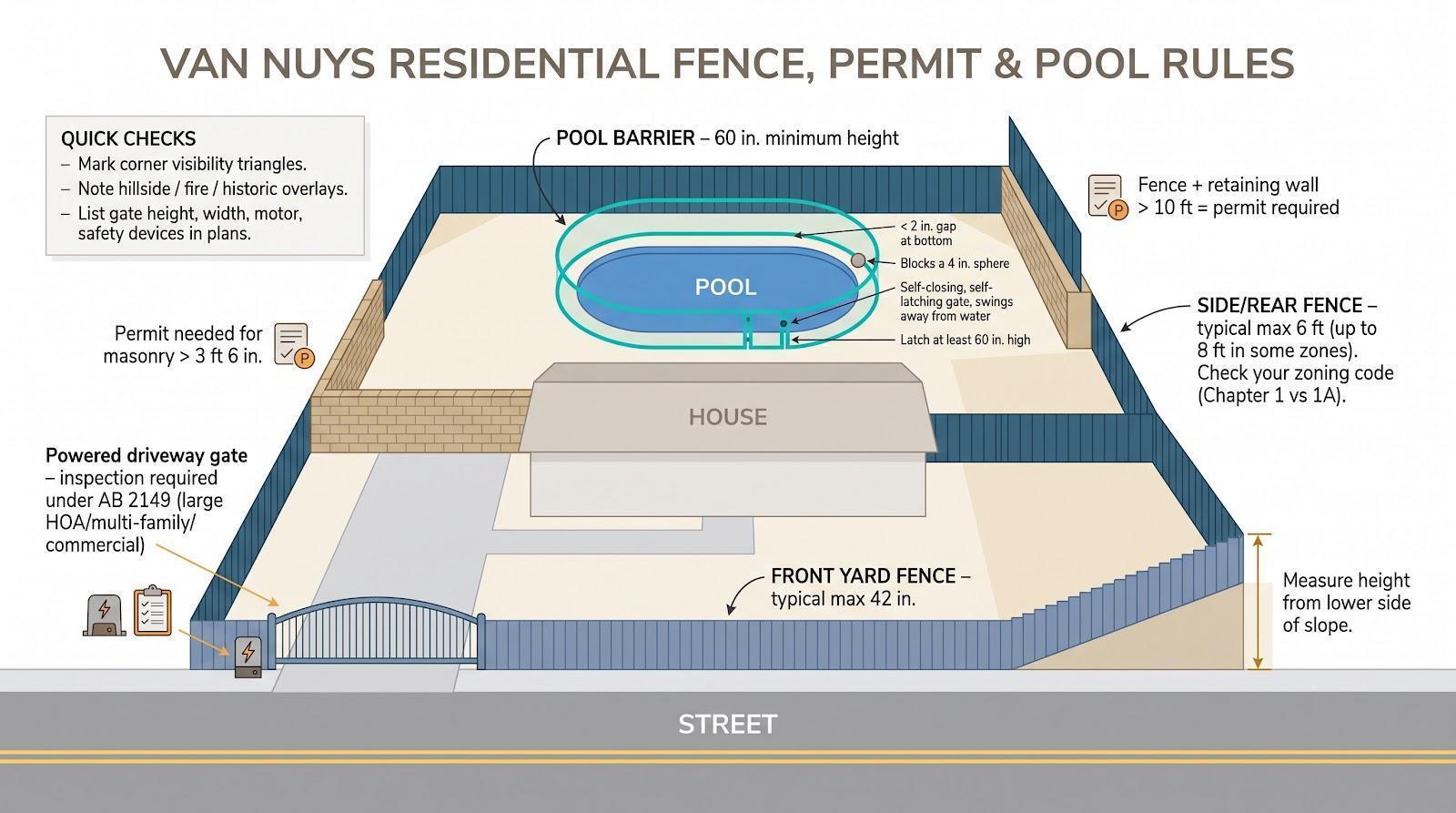
Before you price panels, open ZIMAS.lacity.org and confirm which zoning code governs your parcel—Los Angeles now runs two sets of rules. Residential fence height and permit rules vary by city (Los Angeles, Van Nuys, Santa Clarita, etc.), though they commonly cap front yards at 42 inches and side or rear yards at 72 inches. Always verify exact limits with your local planning or building department.
1. Which code applies?
Code track
Typical front-yard max*
Typical side or rear max*
Where you will see it
Chapter 1 (legacy)
42 in.
6 ft
Most single-family lots filed before 2024
Chapter 1A (new)
Varies by “frontage district”
Up to 8 ft
Parcels that have migrated into the new zoning layers
*Overlay zones, corner-lot visibility triangles, hillside areas, and historic districts can override these numbers.
2. When is a permit required?
The Los Angeles Department of Building and Safety treats any of the following as building work (Info Bulletin P/ZC 2002-002):
Masonry or concrete fences over 3 ft 6 in.
Wood or vinyl fences more than 10 ft tall when combined with a retaining wall
Structural wall toppers or fences that support surcharge loads
Expect to submit plans through ePlanLA, then pay plan-check and inspection fees based on project valuation.
A fence used as a qualifying pool barrier generally must:
Stand 60 in. above finished grade
Keep the bottom gap under 2 in.
Block a 4-in. sphere anywhere in the barrier
Use self-closing, self-latching gates that swing away from the water
Mount latches at least 60 in. high
Exact requirements vary by local jurisdiction (authority having jurisdiction), so always confirm with your building department.
4. Powered driveway gates
California AB 2149 (2026) requires large “regulated gates” in HOAs, apartments, and commercial drives to be inspected at installation and at least every ten years thereafter. Ask your installer to list how the gate meets the law and who files the inspection record.
5. Five quick checks before you submit plans
Measure grade change—height is measured from the lower side of a slope.
Mark corner cut-offs; visibility triangles override standard heights.
Note overlays (hillside, fire, historic) in ZIMAS; each carries separate limits.
Attach pool-barrier details if any part of the fence encloses water.
List gate height, width, motor type, and safety devices on the plan sheet.
Pulling parcel data and sketches first saves redraw fees later and keeps your project off the red-tag list.
Vinyl fencing in the Valley climate
Summer highs in Van Nuys often reach 100 to 105 °F (according to NOAA’s June 2025 climate summary), and Santa Ana events can bring 50 to 60 mile-per-hour gusts through Valley corridors (National Weather Service wind report, January 2023). Here is what that means for vinyl:
UV and heat
Pigments run through the profile, so fading is slow, but heat makes panels expand.
Ask your installer to show the one-eighth-inch expansion slot left inside each rail.
Confirm the warranty covers discoloration; some limit color claims to ten years.
Wind load
Full-privacy panels act like sails. Specify deeper footings and request aluminum or steel stiffeners on runs longer than 12 ft.
Gates wider than 4 ft should include internal metal frames and adjustable hinges.
Wildfire and Zone 0
Vinyl is combustible. CAL FIRE’s draft Zone 0 rules, which govern the first 5 ft around a structure, recommend non-combustible materials in that zone. Many homeowners stop vinyl a foot short of the wall and insert a steel section. Check current guidance before final design.
Future repairs
Custom colors look great but may disappear if the extruder retires the shade. Ask how long the supplier plans to stock your exact profile and whether the warranty covers color shift.
Bottom line: vinyl outlasts painted wood in Valley sun, but only when expansion, reinforcement, and fire setbacks are engineered into the bid.
How to choose between these companies
If you care most about…
Shortlist company
Showroom access and same-day fabrication
Vinyl Fence Depot
Line-by-line warranty transparency
Pro Vinyl Fencing
Zero-percent financing and a design gallery
GNG Vinyl Fencing
HOA or multi-family paperwork depth
Vinyl Concepts
Fast Northridge turnaround
Vinyl Fence Mart
Exact color matching on small runs
Customize Vinyl Fencing
Emerging local option you will vet yourself
Pacific Vinyl Fences (watch list)
Before you decide, spend one focused hour to:
Pull the company’s CSLB record and confirm bond and workers’ compensation status.
Read the full material and labor warranties, circling any labor exclusions.
Request an itemized quote that separates demolition, gates, permits, and reinforcement.
A little diligence today can spare you years of warranty hassle tomorrow.
Conclusion
Vinyl fencing delivers decades of low-maintenance privacy, but the fine print determines who pays for repairs down the road. Use the rankings, tables, and checklists above to balance speed, warranty strength, and design needs. Verify every license, read every warranty paragraph, and compare at least three written estimates before you sign. Doing the homework now ensures your new fence stands strong—and stays covered—for its full lifetime.
An investor I talked to last spring put a new metal roof on a duplex, paid a premium for it, and told his tenants the thing would outlive the mortgage. Year seven, water in the upstairs bedroom. He assumed he’d been sold junk steel. He hadn’t. The panels were fine — pull one off and they’d have another four decades in them. What died was everything holding those panels down. That’s the pattern with metal, and it’s why owners who spend an afternoon vetting metal roof experts before signing get a 50-year roof, while owners who take the cheapest bid get a 12-year roof that costs the same up front. The metal is rarely the variable. The crew is.
Exposed Fasteners Are a Countdown Timer
Screw-down panels are attached with thousands of screws driven straight through the face of the metal. Each screw has a rubber washer, usually EPDM, and that washer is the only thing standing between rain and your decking.
Rubber doesn’t last fifty years. UV cooks it, temperature cycles compress and release it, and somewhere between year twelve and year twenty it goes brittle and stops sealing. That’s not defect. That’s the material doing what rubber does.
Then there’s torque. A screw driven too hard crushes the washer flat and squeezes it out sideways — no compression left, no seal. Driven too soft and it never seals at all. On a roof with 3,000 fasteners installed by a crew paid by the square, you’re going to get a percentage of both. Maybe two percent. Two percent of 3,000 is sixty potential leak points.
Add thermal cycling. Panels expand and contract, screw holes slowly go oval, and the fastener loses its grip on the wood. Owners who plan properly budget for a full re-screw around year fifteen, swapping every fastener for one a size larger. Most owners have never heard of this until water shows up.
Screw-Down Panels vs Standing Seam: A Choice You Make Once
Where corrugated and R-panel make sense
Barns, detached garages, carports, storage buildings, anything where a leak means a wet floor instead of a insurance claim. Also properties you plan to flip inside five years — the panels look good, they’re cheap, and the failure clock won’t run out on your watch. Nothing wrong with using them. Just know what you bought.
Why standing seam costs more, and why owners pay it
No holes through the panel face. Concealed clips hold each panel to the deck, and adjacent panels lock together at a raised seam that sits above the water line. Rain never sees a fastener. That’s the whole design argument in one sentence, and it’s why standing seam runs 40 to 70 percent more per square.
For a buy-and-hold property with a twenty-year horizon, that math works out. For a two-year flip, it doesn’t.
Thermal movement no one accounts for
A 40-foot steel panel moves roughly a quarter inch between a February morning and an August afternoon. Standing seam handles this with floating clips that let the panel slide. Screw-down systems handle it by fighting it, which is why the holes go oval and the washers wear.
Fix a standing seam panel at both ends — some crews do, out of habit or carelessness — and you’ve removed the one advantage you paid for. Panels buckle. Seams pull open. I’ve seen it on two-year-old roofs.
Galvanic Corrosion: The Chemistry Nobody Checks
Put two dissimilar metals in contact with moisture between them and one of them starts sacrificing itself. Basic chemistry, catastrophic on a roof.
Copper gutters draining onto a steel panel. Galvanized fasteners driven into aluminum. Old lead flashing left around a chimney because tearing it out cost extra. Runoff from pressure-treated lumber, which contains copper compounds that eat galvanized steel with startling enthusiasm.
Year one, nothing. Year three, faint staining at the contact point. Year five, actual pitting, and by then it’s structural.
Where this bites hardest is the seam between two contractors’ work. Roofer does the roof, gutter guy does the gutters six months later, nobody checks material compatibility, and the owner pays for a mistake neither of them will admit to. Ask about metal compatibility before the second trade shows up, not after.
Flashing, Penetrations, and Sealant That Was Supposed to Be Temporary
Every hole in a roof is a future leak that’s been postponed. Chimneys, plumbing stacks, bath fan vents, ridge caps, wall abutments, skylights.
Done right, flashing is mechanical — formed metal that laps water out by geometry alone. Sealant goes on as a secondary layer, backup for the primary detail. Done wrong, sealant is the detail. A crew that runs a fat bead of butyl around a pipe boot and calls it finished has bought you six years, maybe eight in a mild climate.
Sealant is consumable. Say it out loud when you’re reading a bid. If the estimator describes penetrations in terms of caulk rather than formed flashing or properly specified boots, you’re looking at a maintenance schedule disguised as a roof.
Ridge details deserve their own paragraph. Closed-cell foam closure strips at the ridge and eave are cheap, tiny, and constantly skipped. Without them you get wind-driven rain, insects, and birds nesting under corrugation. Sounds minor. It isn’t.
What Goes Under the Panel Matters as Much as the Panel
Metal doesn’t waterproof a roof by itself. The underlayment does a share of the work, and it’s invisible the moment panels go on — which is exactly why it gets cheapened.
Felt paper under metal is a bad idea in the Northeast. Panel surface temperatures hit 160 degrees, felt dries out and cracks, and by year ten there’s nothing down there. Synthetic underlayment handles the heat. High-temp ice and water shield along eaves and in valleys handles the February problem, when ice dams back water uphill.
Then condensation. Metal on an unvented or poorly vented assembly sweats on the underside in winter — warm moist air from inside hits a cold panel and drips onto the deck. Rust that starts on the inside face of the panel and works outward, plus rotting sheathing, plus insulation losing its R-value. Owners chase this for years thinking they have a leak. Proper ridge and soffit venting, or a closed-cell foam assembly if the design calls for it. There’s no third option.
Coatings, Gauge, and Warranty Language That Doesn’t Mean What You Think
Galvalume outperforms plain galvanized in most environments — aluminum-zinc coating, better corrosion resistance, longer life at the cut edges. Worth specifying by name.
Paint system matters more than owners expect. PVDF, sold as Kynar 500, holds color and gloss for decades. SMP is cheaper and chalks noticeably by year twelve. On a rental where curb appeal drives your applicant pool, chalking is a real cost.
Gauge: 29 is thin, 26 is standard for residential, 24 for commercial and premium standing seam. Thinner metal oil-cans more, dents easier, and telegraphs every imperfection in the deck.
Now the warranty. A 40-year manufacturer warranty usually covers finish — fade, chalk, maybe perforation from rust. It covers nothing about installation, and installation is where roofs fail. The contractor’s workmanship warranty is the one that pays for water in a bedroom. Two years is common. Ten is what a serious crew offers. If a company won’t put labor coverage in writing, they’ve told you what they think of their own work.
How to Vet the Crew Before They Touch the Roof
Ask how many metal roofs they installed last year. Not roofs — metal roofs. Shingle contractors take metal jobs when work is slow, and the details don’t transfer.
Ask whether they run standing seam or only screw-down. Ask if they own a brake and roll-form panels on site, or order everything pre-cut. Ask what they do at a chimney, and listen for whether the answer involves formed metal or a tube.
Then ask for addresses of jobs from eight years ago. Anyone can show you a roof they finished last month. A roof that’s been through eight winters tells you everything.
The Failure Timeline on a Badly Installed Metal Roof
Year two or three: a few fasteners back out, a couple of panels tick in the wind. Nobody notices.
Year five: staining at contact points, first rust freckles at cut edges, sealant beads cracking where sun hits them.
Year seven: water at a penetration or a wall abutment. This is when the owner calls somebody, usually for a patch.
Year ten: underlayment is spent, decking has been damp through multiple winters, and the fix is no longer a repair. Full tear-off, on a roof sold as lasting half a century.
Match that against your hold period and the decision makes itself.
Compelling text helps residential buildings in Utah attract interest and motivates serious investors to ask for additional details – these written summaries provide a chance for owners to justify the monetary value of a property. Sellers utilize these descriptions to catalog significant structural elements, explain the current condition of the building and illustrate the habitual activities of residents within the home.
Present The Property Clearly
Opening sentences are most effective when they communicate essential information quickly – these lines include the building type, general location, counts for bedrooms and bathrooms and notable characteristics. Because buyers often scan text, the first paragraph is a tool to help them decide if the house meets their requirements.
Professional tones are necessary throughout the text – Descriptions are more reliable when they avoid exaggerations and focus on facts that buyers can evaluate. For instance, explaining that a kitchen includes stainless steel appliances and oak cabinets is more helpful than calling the room impressive.
Highlight Important Home Features
Listing descriptions explain the specific attributes that differentiate a house from others after the basic facts are present. Examples of these features are renovations, functional rooms, outdoor areas, storage and natural light. Details about updated flooring or a new heating system are indicators of the value and condition of the property.
Practical uses for different rooms are also worth mentioning. An extra bedroom is a possible office or guest space, while an open floor plan is a flexible area for social gatherings. Sellers provide enough information for readers to imagine their own lives in the space while the text remains factual.
Describe The Utah Location
Proximity to local services is a major factor for Utah properties. Descriptions should list nearby grocery stores, schools, parks, highways and employment centers. Specific details help buyers understand how the house fits into a daily schedule.
Accuracy is vital for location statements – Instead of claiming a house is near every destination, authors provide context about specific travel times or distances. Real estate professionals can ensure these descriptions are correct. Sellers who use flat rate realtor Utah should also ensure their strategy focuses on both the building and the neighborhood.
Use Specific And Useful Language
Precise language is more effective than the use of many adjectives. Descriptions are stronger when they mention large windows or hardwood floors rather than using words like beautiful or amazing – these details are data points that buyers use to compare different houses.
Readability is important for buyers who look at many listings. Short paragraphs and simple sentences are easy to navigate. Each section of the text is an opportunity to discuss a new aspect of the property without repeating information.
Emphasize Recent Improvements
Maintenance history is clearer when the text highlights recent upgrades. Sellers should mention new roofs, updated plumbing or recent landscaping. Including the dates of the projects is a way to provide context for the maintenance of the house.
Distinctions between finished projects and future plans are necessary for honesty. A listing is inaccurate if it claims a renovation is complete when the work is still in progress. Accurate text builds trust with buyers and prevents confusion during the sale.
Create A Professional Final Description
Reviews for spelling and accuracy are the final steps before a seller publishes a listing. Room counts and measurements must match official property records. Factual errors are distractions that create unnecessary questions for the seller.
Final versions of the text are balanced and encourage buyers to visit the house. The words are additions to the professional photographs rather than simple repetitions of the images. When the text combines facts and location details, the listing is more informative for Utah buyers.
Conclusion
Strong Utah property descriptions are the result of accurate information and professional writing. Sellers highlight features and explain the location to help buyers understand the value of the home. A focused description is a tool that encourages prospects to schedule a showing.